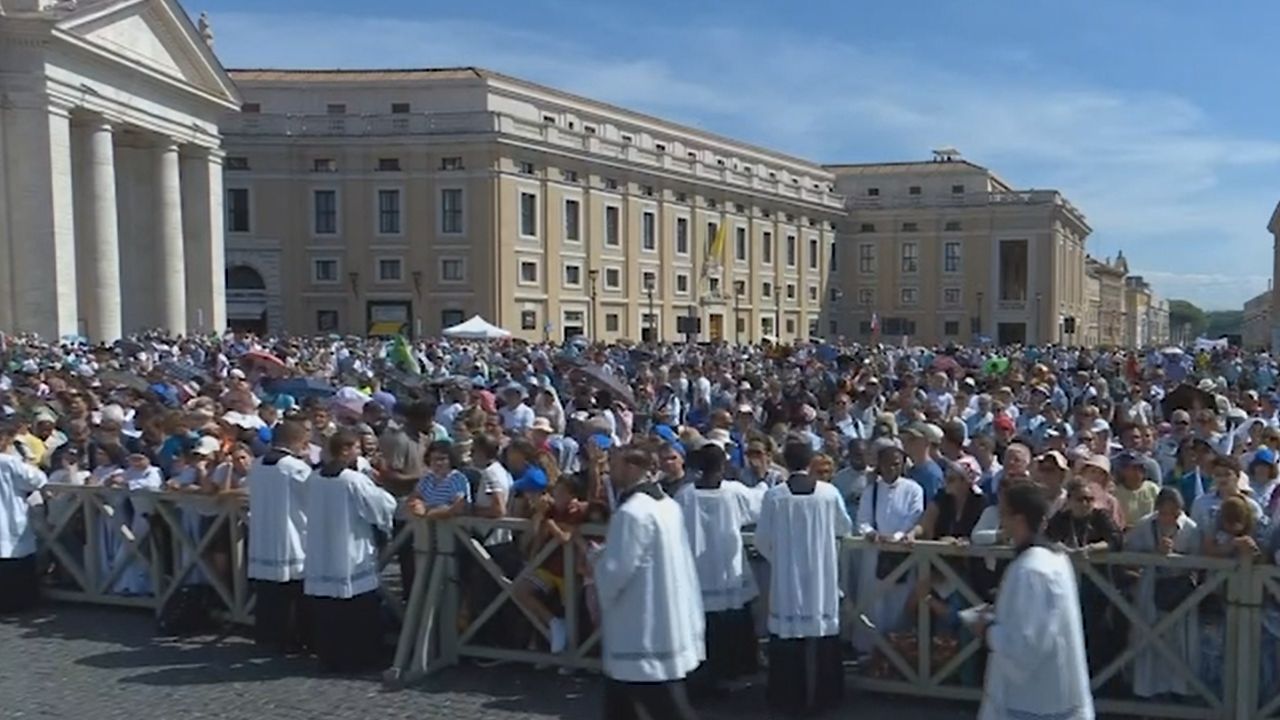
Would St. Peter’s Basilica survive an earthquake? And the foundations on which it was built—are they safe? Not even the Catholic Church's premier basilica is exempt from the risks of natural disasters.
Aware of the unpredictable reality of natural disasters, the Vatican has undertaken a major risk and safety analysis of St. Peter's structural integrity to help preserve the massive church.
ANNALISA MUCCIOLI
Head of R&D and Technical Functions at Eni
No surprise—here, simply put, today there is, and with greater knowledge it will let us prevent possible future events, but knowledge should not worry us; knowledge is a tool that lets us preserve.
The entire church will be monitored by thousands of sensors, which will allow engineers and technicians at the Vatican to keep a pulse on the architectural health or problems of the basilica.
ALBERTO CAPITANUCCI
Senior Advisor, Fabric of St. Peter
We have different orders of magnitude with respect to the problems; some are resolved simply by saying “go,” others I don’t know, others we do not know. How to proceed where they might manifest themselves, because there is a need for preparation, a mobilization. It took 18 months to design a monitoring model. Now, in strictly clinical terms, a monumental building that has centuries behind its shoulders is entirely comparable to an elderly person.
This complex project to maintain St. Peter's is called “Beyond the Invisible.” It is being financed by the Italian company Eni, which the Vatican has worked with in the past. There are no official figures on the cost of the major project, but Eni has shared estimates.
CLAUDIO GRANATA
Director, Stakeholder Relations at Eni
How can one state the cost to someone to whom a donation has been made? But a few hundred thousand euros. No more. However, I repeat, it is an element that makes the difference between donating something and invoicing.
To best understand the magnitude of the basilica, it helps to know its history. The first version was built in the 4th century over the tomb of Saint Peter by Emperor Constantine, but it wouldn't last the test of time.
Pope Julius II decided to demolish it in 1506 because of its poor structural condition. He then built the current version of St. Peter's basilica that many know and love today.
CARD. MAURO GAMBETTI
Archpriest, St. Peter's Basilica
If Pope Julius II had to opt, at that time, for the demolition and reconstruction of the Church, in order to allow the renewal of a compromised structure, as I said at the beginning, today Pope Leo can afford to renew without demolishing, thinking serenely of this basilica that pilgrims and visitors will be able to experience in the next quarter millennium.
The current St. Peter's was formally inaugurated on November 18, 1626, which means this year is the fourth centenary of the major basilica. The Vatican will mark the occasion with special celebrations, last of which will be a papal Mass on the date of the basilica's inauguration.