Due to the historical events that prevented the conclusion of the First Vatican Council, many of the questions that were intended to be addressed were left unresolved. Ecclesiastical discipline, how to understand the structure of the Church, was one of these questions.
Only one major point was addressed during the council: the question of papal infallibility.
PEDRO LUIS VIVES
Expert in ecclesiology
It is an ecclesiology that reflects a pyramidal structure of the Church. Because, in effect, it is an ecclesiology that above all tends to protect, defend, safeguard, and in that sense to propose the primatial character of the successor of Peter.
It is a markedly juridical ecclesiology.
It was from this council that the Church promulgated the dogma of papal infallibility: when the Pope speaks ex cathedra on matters of faith and morals, he is preserved from error through the assistance of the Holy Spirit.
The proclamation of this dogma served as a response to liberal movements threatening the doctrine and unity of the Church.
But after Vatican I, in 1943, Pope Pius XII published Mystici Corporis, an encyclical that addressed ecclesiology on a broader level.
PEDRO LUIS VIVES
Expert in ecclesiology
The intention of Pius XII with that encyclical was to offer a notion, a definition of the Church based on the Pauline concept of the “Body of Christ,” and therefore it offers us a vision of the Church as the Mystical Body of Christ.
This shift in focus emphasized the necessary role of not only the hierarchy of the Church but also all the faithful, clergy or not.
This focus, together with the emergence of various reform movements — such as the liturgical and biblical movements — provided the groundwork for understanding the ecclesiology that would shape Vatican II, convened by Pope St. John XXIII.
PEDRO LUIS VIVES
Expert in ecclesiology
With the ecclesiology of Vatican II there is a shift from a pyramidal vision of the Church to a vision of the Church understood as communion. Therefore, to the architectural image of the pyramid we could contrast the geometric image of the sphere.
The Second Vatican Council sought to express a deeper theological and biblical definition of the Church, some more comprehensive in which all the baptized would have a mission. This change in perspective became the driving force behind one of the council's most important documents.
PEDRO LUIS VIVES
Expert in ecclesiology
This change that occurred in ecclesiology is known as the famous “Copernican turn” in the history of the drafting of the most important document for Vatican II ecclesiology, which would be the dogmatic constitution Lumen Gentium.
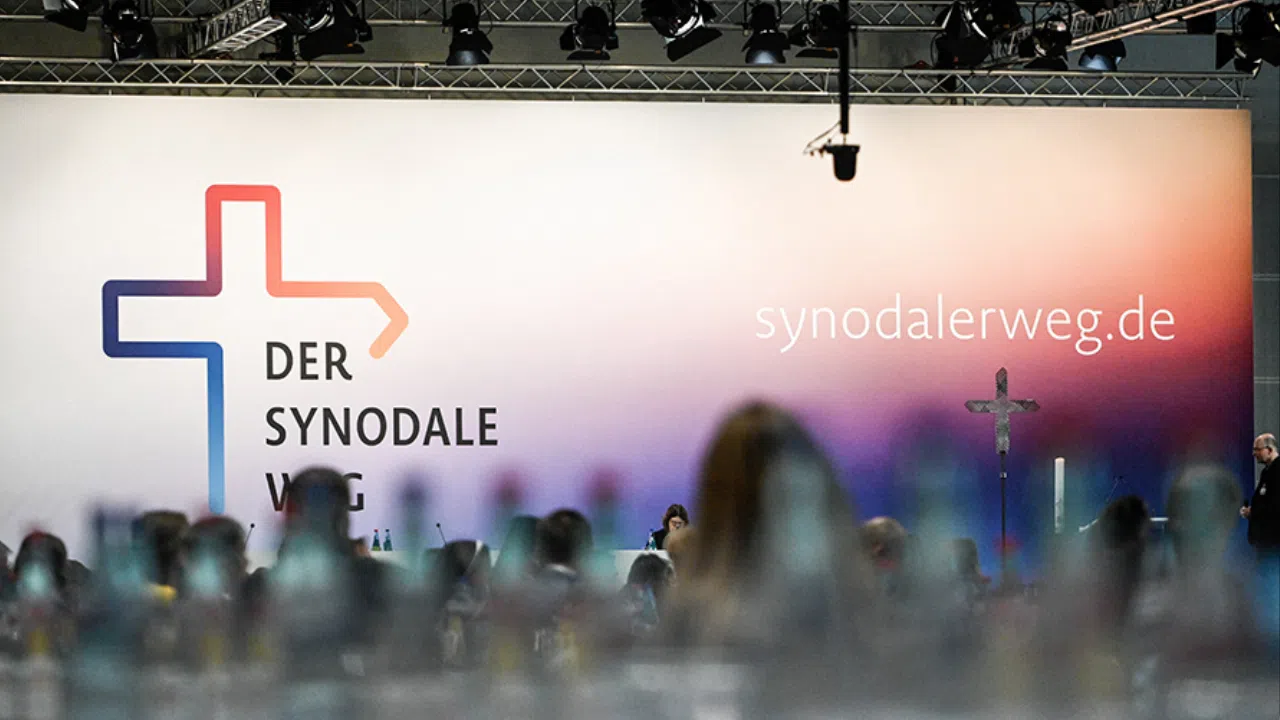
The definition of the Church provided by Lumen Gentium offers major contributions to today’s ecclesial discussions. The Synod on Synodality, for example, draws from this document, heavily emphasizing the image of “the People of God.”
PEDRO LUIS VIVES
Expert in ecclesiology
Synod means “walking together.” Therefore, the idea of a journey implies an itinerary. That idea of itinerancy is closely connected with the image of the Church as the People of God—a People of God who walk through time.
It is a journey that has a destination. It is not a path that disappears into the horizon; it has a goal, and the goal is to walk in order to encounter Christ, to be united with Christ.
The synodal approach seen today is an effort to practice this ecclesial emphasis proposed sixty years ago at the Second Vatican Council.
JUAN CARLOS GARCÍA
Director, Library of Christian Authors
This structure of walking together, of encountering one another, is a mature fruit of the Second Vatican Council.
I think we have taken a step—a giant step. We can, I think, be pleased, but not satisfied, with the path taken. There is much still to be done, but much has already been accomplished.
Without fundamentally changing the distinct role of the clergy, the vital role of laypeople within the Church is an ongoing question for the hierarchy. According to some, it a question that must be resolved.
JUAN CARLOS GARCÍA
Director, Library of Christian Authors
In a Church of the baptized—of laity and ministers—in a Church that seeks to evangelize, the lay path is irreversible.
The Vatican continues to work through the concrete implications of the Church's calls for ecclesial renewal and what it means for all the faithful to live within the Body of Christ.
AM/CA/JRB