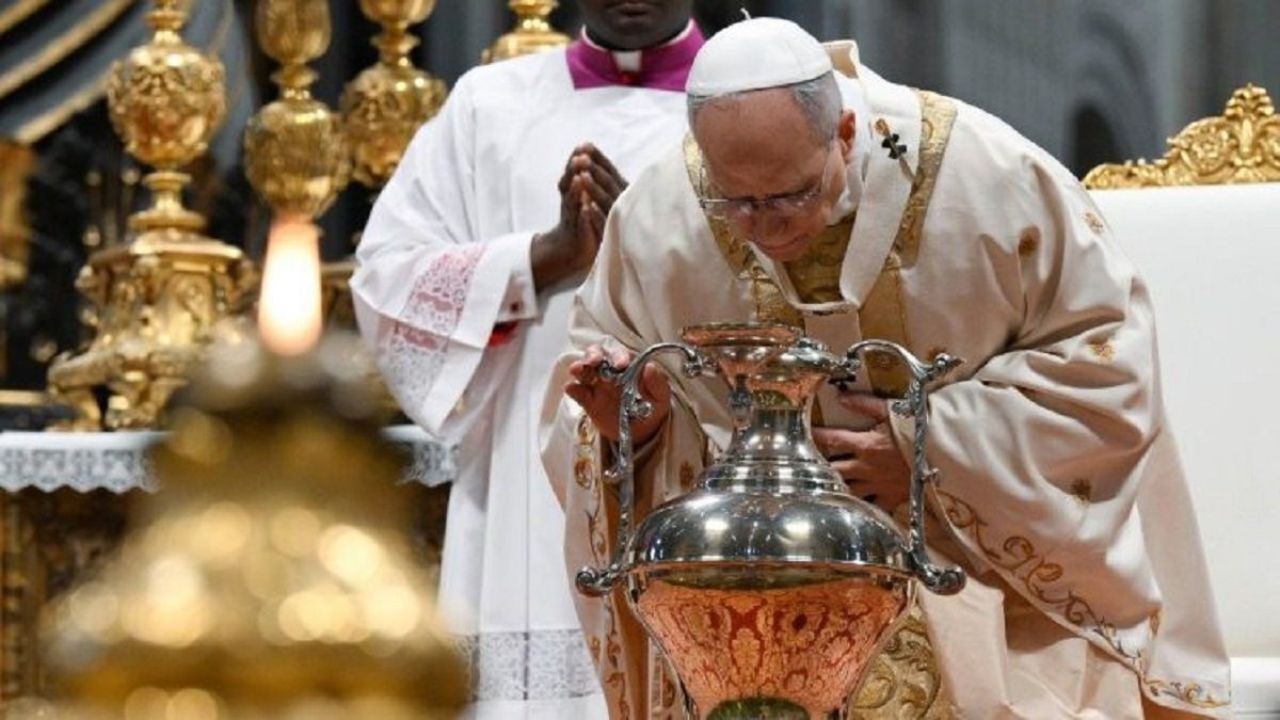
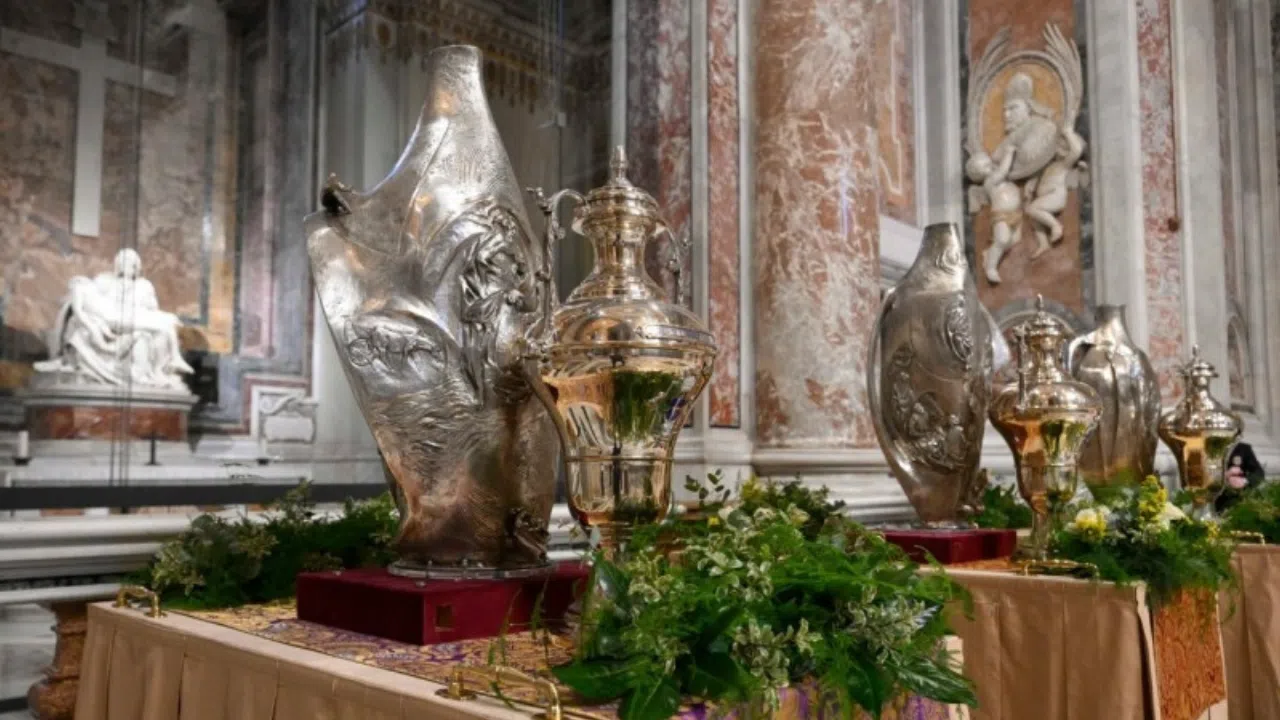
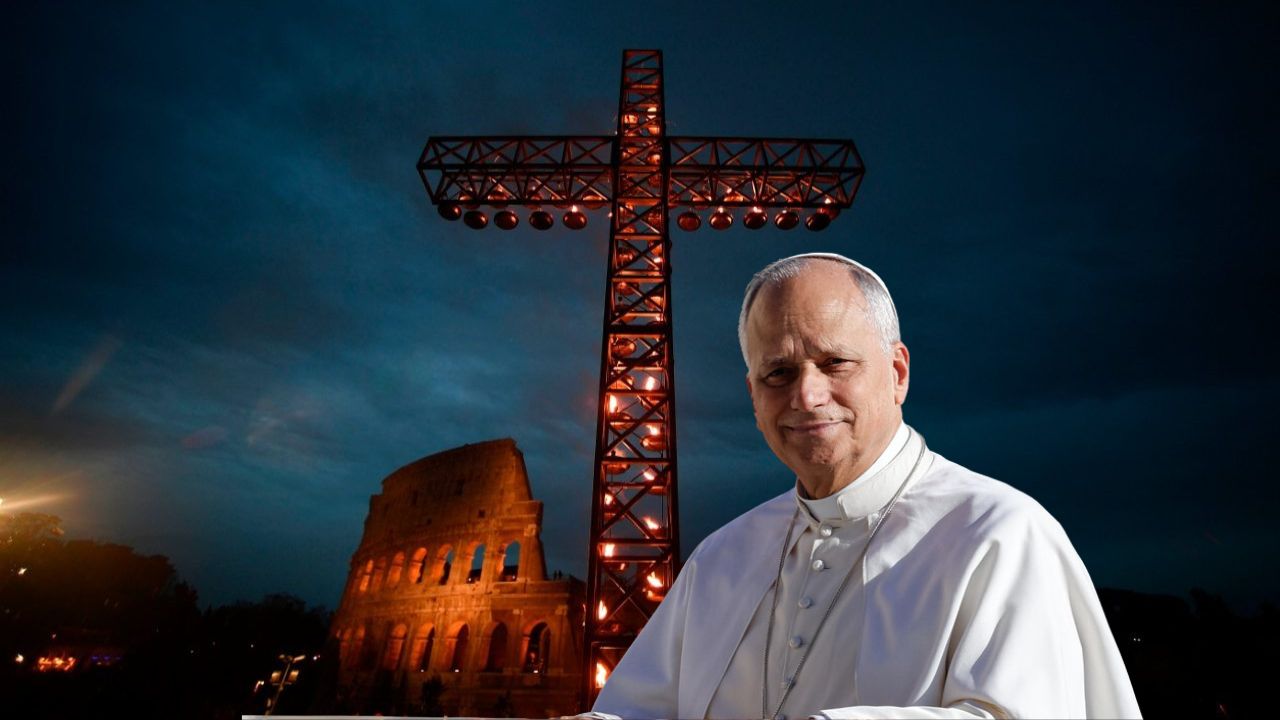
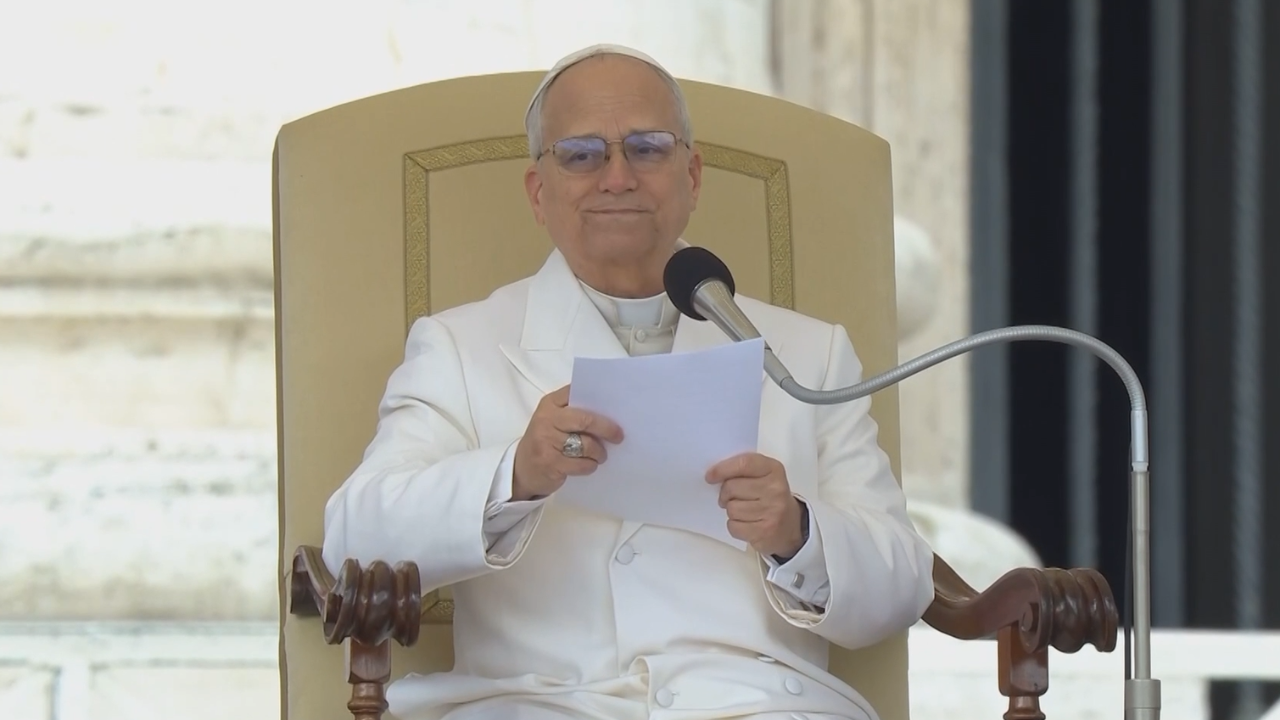
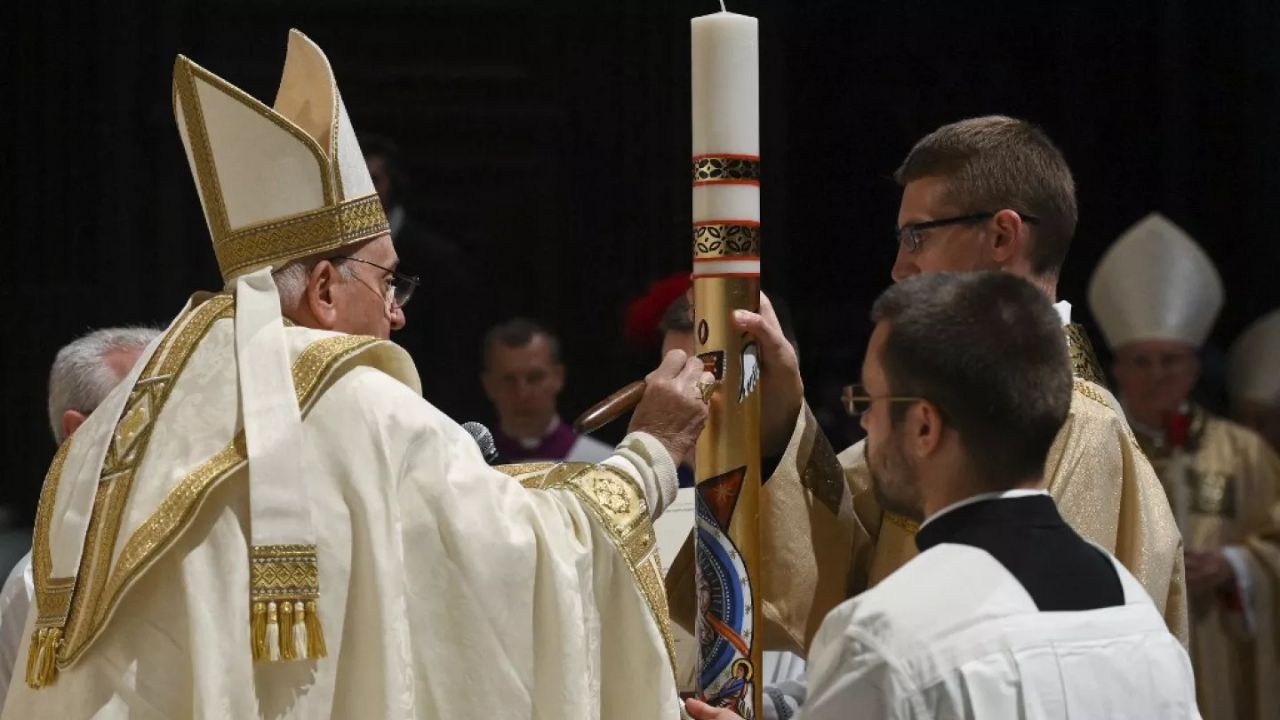
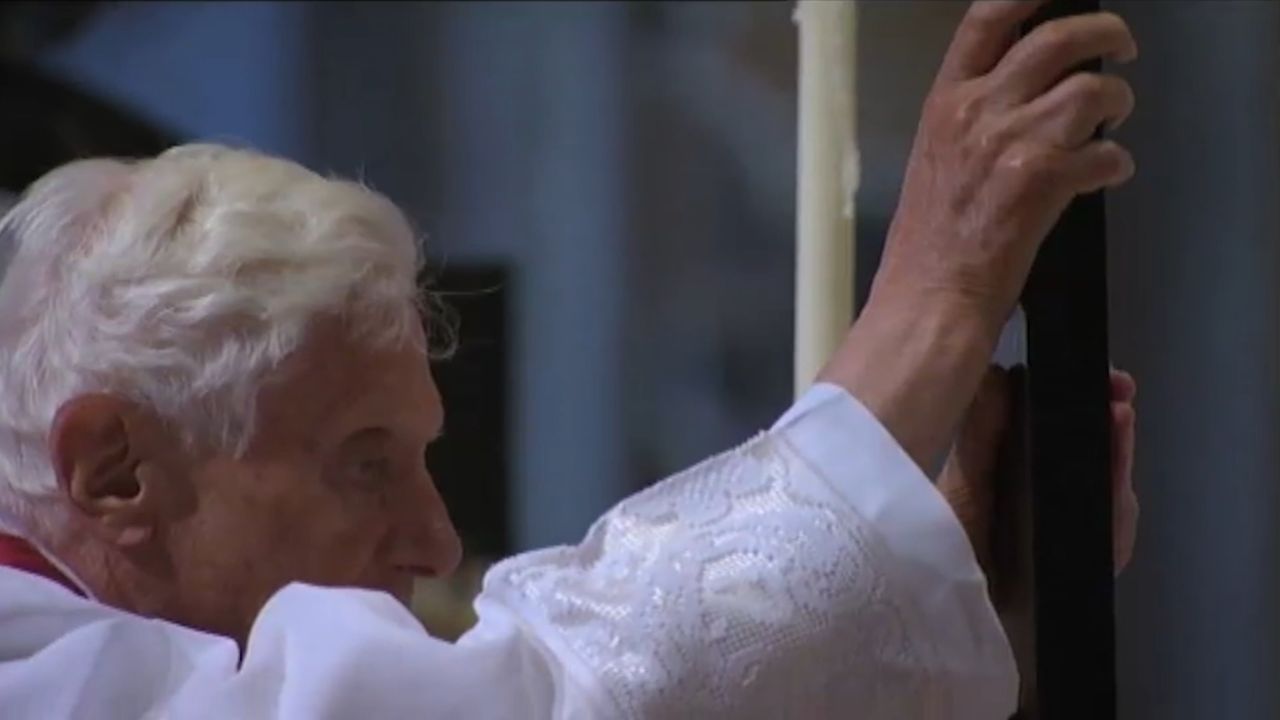
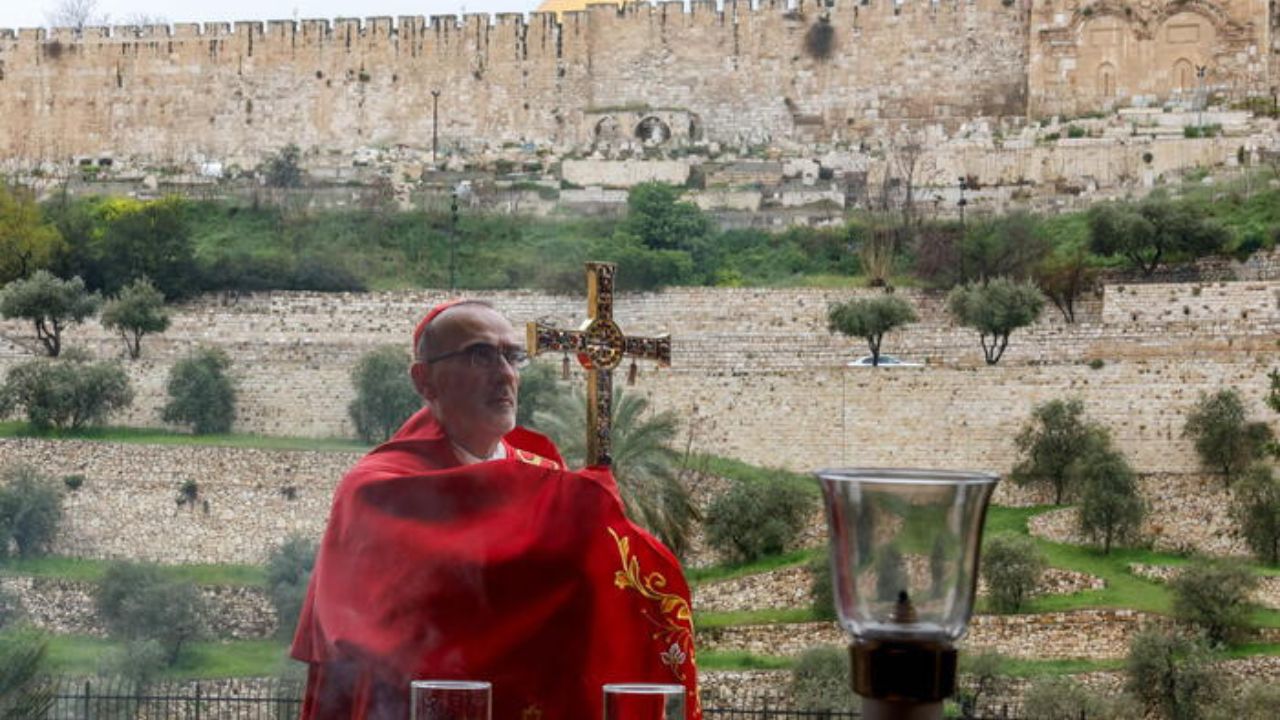
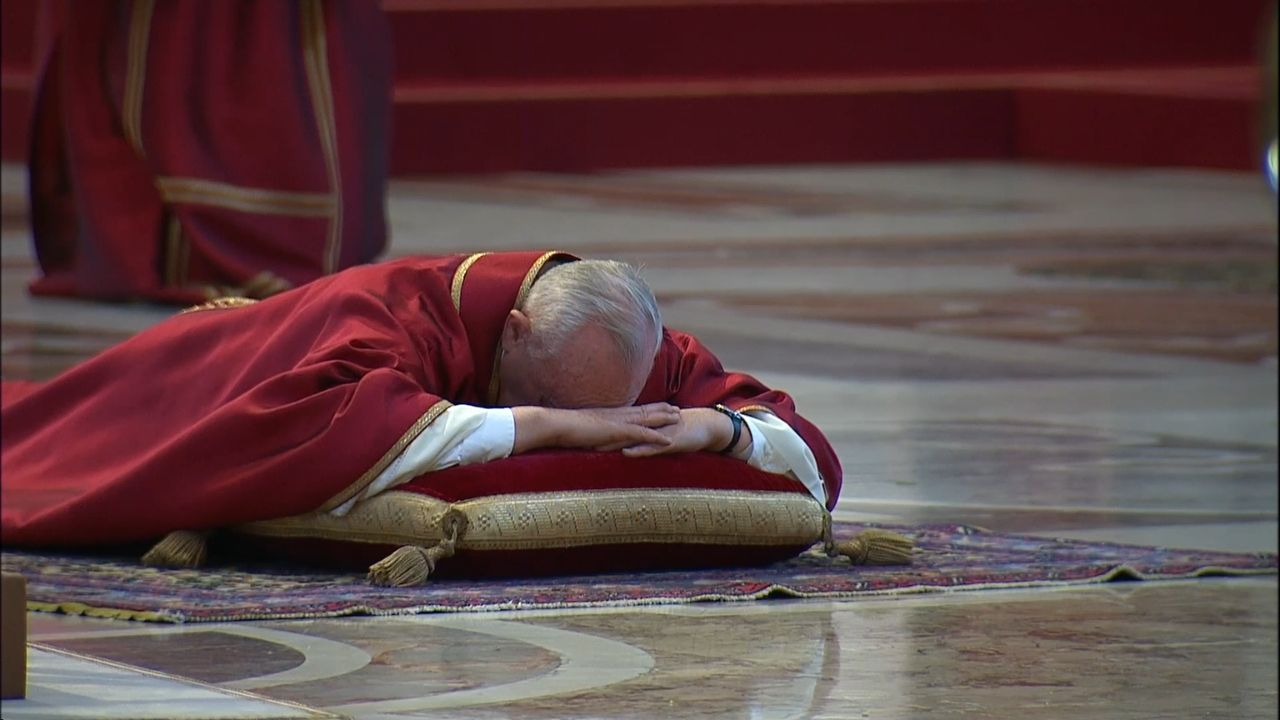
It was the first time that Pope Leo XIV presided as pontiff over the Chrism Mass, in which the sacred oils used in the administration of the different sacraments throughout the year are blessed.
In addition, during this Eucharistic celebration, priests renew the promises they made at their ordination, as they take part in this Mass prior to the beginning of the Easter Triduum.
These were the words Pope Leo XIV addressed to them during the homily:
Dear brothers and sisters,
We are now on the threshold of the Easter Triduum. Once again, the Lord will lead us to the culmination of his mission, so that his passion, death and resurrection may become the heart of our mission. What we are about to relive, in fact, possesses the power to transform what human pride generally tends to harden: our identity and our place in the world. Jesus’ freedom changes hearts, heals wounds, refreshes and brightens our faces, reconciles and gathers us together, and forgives and raises us up. In this, my first year presiding over the Chrism Mass as Bishop of Rome, I would like to reflect with you on the mission to which God calls us as his people. It is the Christian mission, the very same as Jesus’, not another. Each of us takes part in it according to our own vocation in a deeply personal obedience to the voice of the Spirit, yet never without others, never neglecting or breaking communion! Bishops and priests, as we renew our promises, we are at the service of a missionary people. Together with all the baptized, we are the Body of Christ, anointed by his Spirit of freedom and consolation, the Spirit of prophecy and unity. What Jesus experiences at the culminating moments of his mission is foreshadowed by the passage from Isaiah, which he quoted in the synagogue at Nazareth as the word that is fulfilled “today” (cf. Lk 4:21). Indeed, at the hour of Easter, it becomes definitively clear that God consecrates in order to send. “He has sent me” (Lk 4:18), says Jesus, describing that movement which binds his Body to the poor, to prisoners, to those groping in the dark and to those who are oppressed. We, as members of his Body, speak of a Church that is “apostolic,” sent out, driven beyond itself, and consecrated to God in the service of his creatures. “As the Father has sent me, so I send you” (Jn 20:21). We know that being sent entails, first and foremost, a detachment, that is, the risk of leaving behind what is familiar and certain, in order to venture into something new. It is interesting that “with the power of the Spirit” (Lk 4:14), who descended upon him after his baptism in the Jordan, Jesus returned to Galilee and came “to Nazareth, where he had been brought up” (Lk 4:16). It is the place he must now leave behind. He moves “as was his custom” (v. 16), but to usher in a new era. He must now leave that village for good, so that what has taken root there, Sabbath after Sabbath, through faithful listening to the word of God, may come to fruition. Likewise, he will call others to set out, to take risks, so that no place becomes a prison, no identity a hiding place. Dear friends, we follow Jesus who “did not regard equality with God as something to be exploited, but emptied himself” (Phil 2:6-7). Every mission begins with that kind of self-emptying in which everything is reborn. Our dignity as sons and daughters of God cannot be taken from us, nor can it be lost, but neither can the affections, places, and experiences at the start of our lives be erased. We are heirs to so much good and, at the same time, to the limitations of a history into which the Gospel must bring light and salvation, forgiveness and healing. Thus, there is no mission without reconciliation with our past, with the gifts and limitations of the upbringing we have received; but, at the same time, there is no peace without setting out, no awareness without detachment, no joy without risk. We are the Body of Christ if we move forward, coming to terms with the past without being imprisoned by it: everything is restored and multiplied if it is first let go, without fear. This is a fundamental secret of mission. It is not something that is experienced just once, but in every new beginning, in every new sending forth. Jesus’ journey reveals to us that the willingness to lose oneself, to empty oneself, is not an end in itself, but a condition for encounter and intimacy. Love is true only when it is unguarded; it requires little fuss, no ostentation, and gently cherishes weakness and vulnerability. We struggle to commit ourselves to a mission that exposes us in this way, and yet there is no “good news to the poor” (cf. Lk 4:18) if we go to them bearing the signs of power, nor is there authentic liberation unless we free ourselves from attachment. Here we touch upon a second secret of the Christian mission. After detachment comes the law of encounter. We know that throughout history, mission has not infrequently been distorted by a desire for domination, entirely foreign to the way of Jesus Christ. Saint John Paul II had the clarity and courage to recognize that “because of the bond which unites us to one another in the Mystical Body, all of us, though not personally responsible and without encroaching on the judgment of God who alone knows every heart, bear the burden of the errors and faults of those who have gone before us. Consequently, it is now a priority to remember that neither in the pastoral sphere nor in the social and political spheres can good come from abuse of power. The great missionaries bear witnesses to quiet, unobtrusive approaches, whose method is the sharing of life, selfless service, the renunciation of any calculated strategy, dialogue and respect. It is the way of the Incarnation, which always takes the form of inculturation. Salvation, in fact, can only be received by each person through his or her native language. “How is it that we hear, each of us, in our own native language?” (Acts 2:8). The surprise of Pentecost is repeated when we do not presume to control God’s timing, but place our trust in the Holy Spirit, who “is present, even today, as in the time of Jesus and the Apostles: is present and at work, arriving before us, working harder than us and better than us; it is not for us to sow or awaken him, but first and foremost to recognize him, welcome him, go along with him, make way for him, and follow him. He is present and has never lost heart regarding our times; on the contrary, he smiles, dances, penetrates, engulfs, envelops, and reaches even where we would never have imagined.” To establish this harmony with the transcendent, we must go where we are sent with simplicity, respecting the mystery that every person and every community carries within them. As Christians, we are guests. This is also true if we are bishops, priests, or men and women religious. To be hosts, in fact, we must learn to be guests ourselves. Even the places where secularization seems most advanced are not lands to be conquered or reconquered: “New cultures are constantly being born in these vast new expanses where Christians are no longer the customary interpreters or generators of meaning. Instead, they themselves take from these cultures new languages, symbols, messages and paradigms which propose new approaches to life, approaches often in contrast with the Gospel of Jesus… It must reach the places where new narratives and paradigms are being formed, bringing the word of Jesus to the inmost soul of our cities.” This happens only if we walk together as the Church, if mission is not a heroic adventure reserved for a few, but the living witness of a Body with many members. There is also a third dimension, perhaps the most radical, of the Christian mission. The dramatic possibility of misunderstanding and rejection, which is already seen in the violent reaction of the people of Nazareth to Jesus’ words. “When they heard this, all in the synagogue were filled with rage. They got up, drove him out of the town, and led him to the brow of the hill on which their town was built, so that they might hurl him off the cliff” (Lk 4:28-29). Although the liturgical reading has omitted this part, what we are about to celebrate this evening calls on us not to flee, but to “pass through” the trial, just as Jesus did, who, “passed through the midst of them and went on his way” (Lk 4:30). The cross is part of the mission: the sending becomes more bitter and frightening, but also more freeing and transformative. The imperialist occupation of the world is thus disrupted from within; the violence that until now has been the law is unmasked. The poor, imprisoned, rejected Messiah descends into the darkness of death, yet in so doing he brings a new creation to light. How many “resurrections” are we called to experience when, free from a defensive attitude, we immerse ourselves in service like a seed in the earth! In life, we may face situations where everything seems to be over. We then ask ourselves whether the mission has been in vain. While it is true that, unlike Jesus, we also experience failures that stem from our own shortcomings or those of others, often from a tangled web of responsibilities, of light and shadow, we can make the hope of many witnesses our own. I recall two who are particularly dear to me. A month before his death, in his notebook for the Spiritual Exercises, the holy Bishop Óscar Arnulfo Romero wrote: ‘The nuncio in Costa Rica has warned me of an imminent danger this very week… These unforeseen circumstances will be faced with God’s grace. Jesus Christ helped the martyrs and, if the need arises, I shall feel him very close when I entrust my last breath to him. But, more than the final moment of life, what matters is to give him one’s whole life and to live for him… It is enough for me, to be happy and confident, to know with certainty that in him is my life and my death; that, despite my sins, I have placed my trust in him and I shall not be disheartened, for others will continue, with greater wisdom and holiness, the work for the Church and for the homeland.” Cardinal Joseph Bernardin, Archbishop of Chicago, said with a smile to journalists two months before his death: “I grew up with three great fears: cancer, death, and one day being falsely accused. As things turned out, I had to face them all unexpectedly. I discovered I was no longer afraid. I believe all this is due to faith… My prayers have made me stronger than I thought I was.” Dearest sisters and brothers, the saints make history. This is the message of Revelation: “Grace to you and peace from him who is and who was and who is to come, and from the seven spirits who are before his throne” (Rev 1:4). This greeting encapsulates Jesus’ journey in a world torn apart by the powers that ravage it. Within it arises a new people, not of victims, but of witnesses. In this dark hour of history, it has pleased God to send us to spread the fragrance of Christ where the stench of death reigns. Let us renew our “yes” to this mission that calls for unity and brings peace. Yes, we are here! Let us overcome the sense of powerlessness and fear! We proclaim your death, O Lord, and we proclaim your resurrection, as we await your coming.