Ana Torres Fonseca
The 19th century, when Barcelona was still lit by gas lamps and there were barely any automobiles, one building was already rising toward the city’s sky.
CHIARA CURTI
Actually, I believe Gaudí did not conceive the Sagrada Familia as a different kind of church. Rather, he envisioned it as the synthesis of all churches, a place where all people could find their home.
While the city was being engulfed in the smoke of the Industrial Revolution, the project that Antoni Gaudí took on in 1883 was heading in another direction:
LLUIS CLAVELL
Instead, he thought: “How can I help the crowds of people who will come here so that, by seeing this, they may be lifted toward God?” When he finished the famous first tower, the one dedicated to Barnabas, he asked a friend, “Does this say anything to you?…Isn’t it true that looking at this tower leads you toward God?”
Instead of drawing blueprints of his architectural works, he built smaller, physical models. He divided the Sagrada Familia into three parts, representing the Nativity, Passion, and Glory of Christ.
LLUIS CLAVELL
But another important thing was study. Because, of course, to build a great cathedral one must also understand liturgy. So he read the twelve volumes of 'The Liturgical Year' by Dom Prosper Guéranger, a Benedictine monk from Solesmes who was one of the leading figures in the liturgical renewal of the Catholic Church in the last century.
The construction of the Sagrada Familia was delayed because it never had state funding, and it relied instead on private donations and alms. Most importantly, Gaudí was convinced of one thing.
LLUIS CLAVELL
“My client,” he used to say, referring to God, “is in no hurry.”
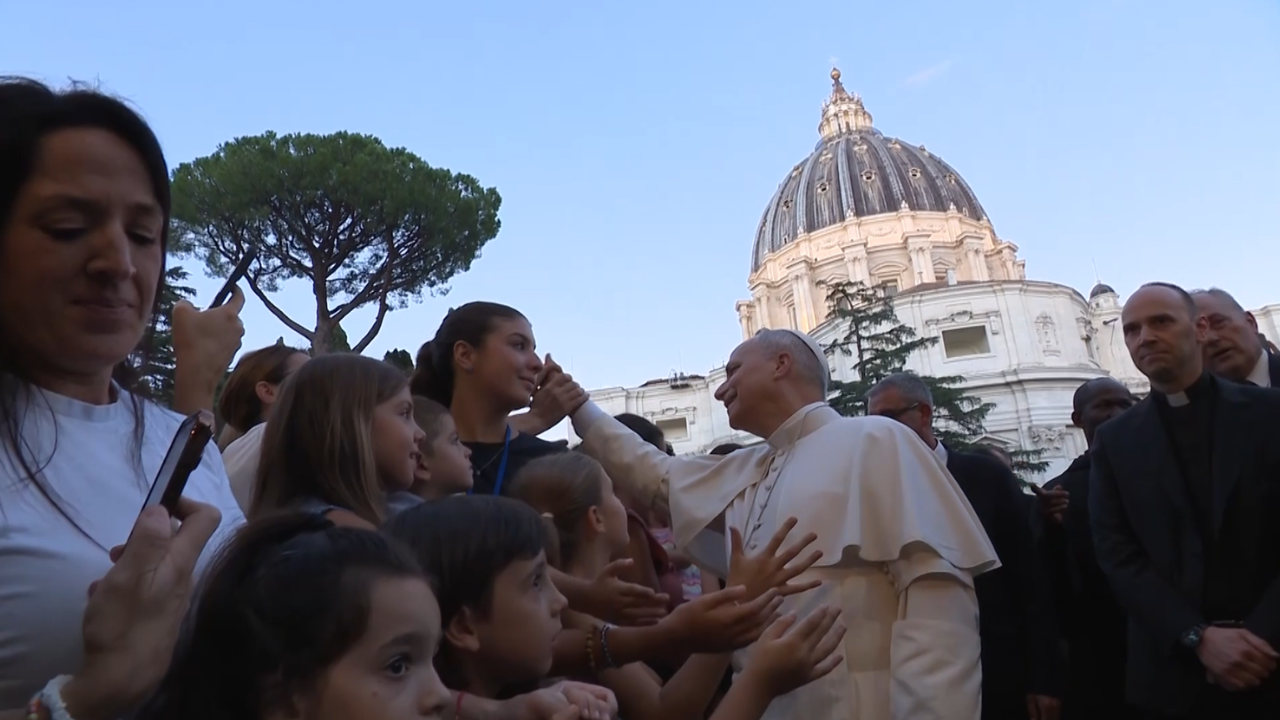
Without this delay, Leo XIV would not have the opportunity he will now have, during his upcoming trip to Spain, to bless the tallest tower of the basilica—the Tower of Jesus, which was only recently completed.
CHIARA CURTI
I think this gesture by the Pope is beautiful, because if you think about it, it may seem a bit disproportionate, right? He is not coming to dedicate it, because it has already been dedicated; he is not coming for its completion, because it is still far from finished. But in reality, he is coming to mark that we are on a journey.
The first pope to visit it was Pope John Paul II in 1982. Decades later, Pope Benedict XVI consecrated it as a minor basilica.
It will now be Pope Leo XIV who blesses the tallest of the 18 towers, which tops off at just over 564 feet. This is precisely so it does not surpass the height of Montjuïc, a nearby hill. Gaudí always maintained that human work should never surpass God’s natural creation.