Carmen Álvarez Cuadrado
One of the biggest controversies Pope Leo XIV inherited from Pope Francis was Germany and the management of its Synodal Path. But Leo knows the issue well—and from the inside.
POPE LEO XIV
I am aware that many Catholics in Germany believe that certain aspects of the Synodal Way that have been celebrated in Germany up until now, do not represent their hope for the Church or their own way of living.
As Cardinal Prevost, Pope Leo had taken part as an important figure in the dialogue between the Vatican and Germany. He was prefect of the Dicastery for Bishops and arrived in 2023, the year in which tensions were at their highest.
The Germans wanted to create a synodal council in which the votes of laypeople and bishops would carry equal weight. But the Vatican wholly rejected this proposed policy.
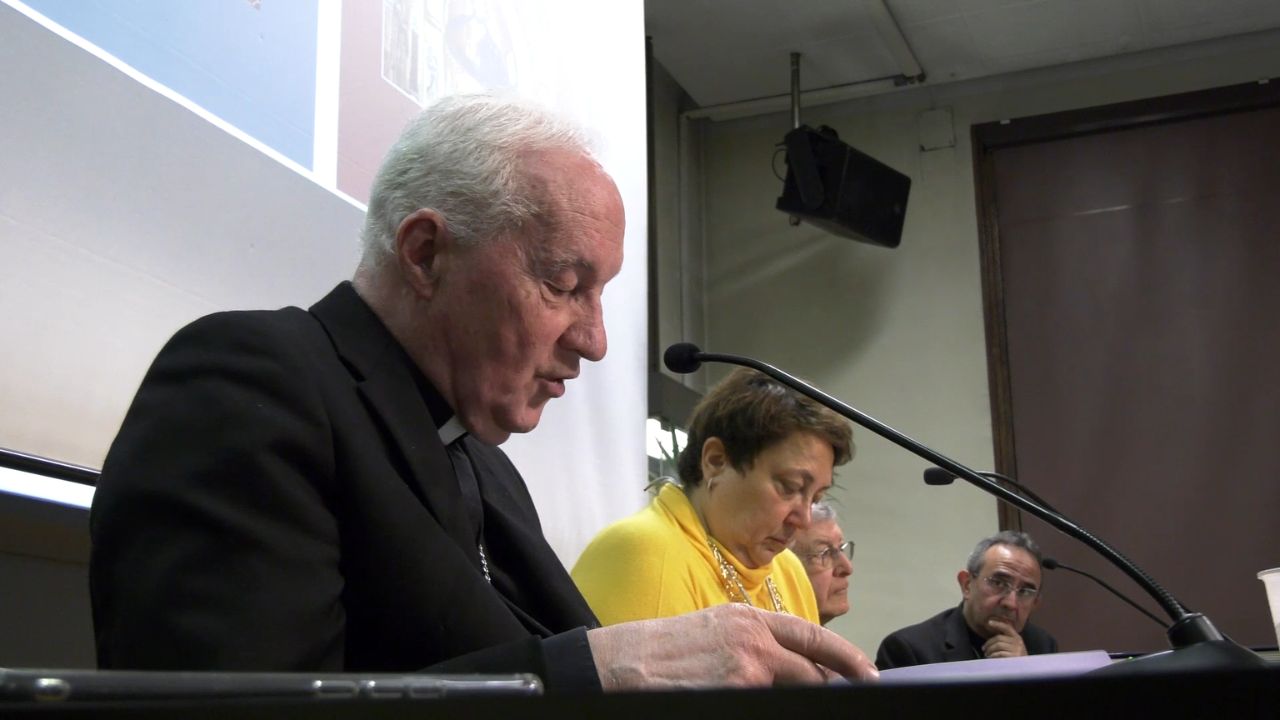
STEFAN MÜCKL
Pontifical University of the Holy Cross
It is about making decisions together with the bishops, but it is only the bishops who must answer to God for what they are doing.
Prevost participated in the first Germany–Holy See meeting in July 2023. Four months earlier, the Vatican had rejected another proposal by the German bishops—they had requested that laypeople be allowed to preach homilies at Mass. The Vatican clarified this was something reserved only for ordained ministers.
In November 2023, another “no” arrived—this time from Cardinal Parolin. Reminding them that only men can be priests, he clarified that the Church’s doctrine on homosexuality is not subject to change because of a synodal council.
STEFAN MÜCKL
Pontifical University of the Holy Cross
The atmosphere and the relationship can only be described as tense, because the Holy See has repeatedly reaffirmed that this project is not acceptable, that it is not in conformity with universal law, nor even with the ecclesiology of the Catholic Church.
By creating a synodal council, the German bishops would establish a parallel “authority” to Rome, one that would confuse matters concerning universal Church teaching—let alone German Catholics. What the Germans did was create a committee, a preliminary step toward the council planned for 2026.
They had intended to vote on the committee’s statutes in February 2024, but then received a harsh letter from the Vatican explicitly denouncing the move because it went against canon law.
And note who signed that letter: Secretary of State Parolin; the prefect of the Dicastery for the Doctrine of the Faith, Víctor Manuel Fernández; and also Robert Francis Prevost, head of the Dicastery for Bishops, now Pope Leo XIV.
Germany and the Holy See met twice more. At the last meeting in June 2024, Rome suggested changing the name from synodal “council” to “conference” in order to avoid confusion over sources of authority. The suggestion was accepted by the Germans.
The statutes were approved by the German lay representatives in November 2025 and by the bishops in February 2026, although with reservations.
STEFAN MÜCKL
Pontifical University of the Holy Cross
This statute was approved by an extremely narrow majority, that is, by just one vote more than the required two-thirds majority. I believe there was also a modification made in order to take into consideration the reservations of a very strong minority, which is certainly also in harmony with the position of the Holy See.
Four bishops, including a cardinal, left the synodal path and do not recognize this new conference. Others remained, provided that everything proceeds in union with Rome.
But the key issue is decision-making. If a proposal passes in a vote that includes laypeople, bishops who go against the vote will have to justify why, always playing defensively.
STEFAN MÜCKL
Pontifical University of the Holy Cross
And also the attempt to force bishops who do not agree to justify themselves publicly, obviously with the expectation of very strong criticism on blogs, in the secularized press, and so on.
The Vatican now has the statutes in hand, presented by the new president of the German bishops’ conference, Heiner Wilmer—a man who knows the Curia, understands how the Holy See functions, and whom many compare temperamentally to Pope Leo. Will the two of them succeed in keeping Germany with Rome?